Read the completion choices first
See the labelled completion-screen example before choosing commission hand-in or an off-rack sale.
The official description allows your own designs to be displayed and sold off the rack. In a public reply, developer Elyaradine says off-the-rack dresses become available after the third commission; money and unlocked items still limit the choices. The illustrated completion screen shows commission, continuation and sale choices. Its sale value belongs to that example, not a repeatable earnings formula.
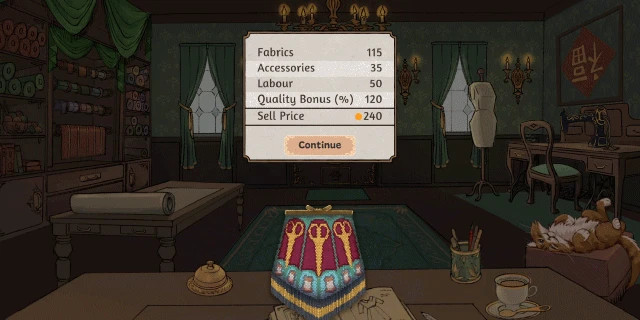
A frame from the May off-rack demonstration displays the sale breakdown before confirmation.
- The breakdown separates Fabrics, Accessories, Labour, Quality Bonus and Sell Price.
- Read it as one historical example; record your own displayed outcome before comparing projects.
Pre-release media published May 27, 2026. This image does not establish the Build 443 interface or item unlocks.
Cozy Lives / Free Lives
Read the original publicationKeep a small project ledger
| Entry | Write down |
|---|---|
| Starting funds | Coins before shopping |
| Planned bill | Fabric and accessory estimate |
| Correction reserve | Funds left for recutting |
| Result | Sale proceeds or commission payment |
Separate fabric from accessories. For a commission, cover the required conditions before spending on optional decoration. For an off-the-rack project, compare the actual sale result with what you put into it. Total inventory value is not this garment’s cost.
Give the next project one purpose
Community players discuss sales as a way to keep working, but we do not have verified profit-per-minute figures. A useful next experiment is a manageable design with fewer last-minute changes and a recorded result. Practice projects and high-cost achievement projects can be planned separately, so one attempt does not carry every goal.
Where to go next
- Dressmaker budget fabrics: buy what the project needs
- Dressmaker commission rejected? Check targets and limits
- Dressmaker customers: preferences, measurements and briefs
What does the historical sale breakdown show?
The May development example lists Fabrics, Accessories, Labour, Quality Bonus and Sell Price above a Confirm button. Read these as the categories shown in that example. The screenshot makes a sale calculation visible, but its individual numbers are not a current price table or a complete formula for every future garment.
For your own record, keep the displayed sale breakdown alongside the materials actually assigned to the project. This lets you compare a fabric-heavy design with one that uses more accessories without confusing new purchases with garment cost.
Which outcome are you choosing?
| Intention | Check before acting | Record afterward |
|---|---|---|
| Complete a customer brief | Customer, requirements and hand-in choice | Acceptance and payment |
| Sell a free design | Off-rack label and displayed sale breakdown | Actual sale result |
| Keep working | Current project and continuation action | The stage you returned to |
| Remove an old off-rack entry | Exact sketchbook entry | That you selected the intended entry |
Build 443 relabels the photo-scene Sell button as Sell as off-rack. It also adds deletion of off-rack dresses from the sketchbook and moves the gifting unlock later. Treat these as separate actions; the patch does not give an exact new gifting chapter in its notes.
How can a sale inform the next project?
Write one conclusion from the actual outcome: an unnecessary purchase, a costly correction or a finishing item you forgot to reserve for. Then change the next project’s plan accordingly. The budget worksheet is a better starting point than an unsupported “best money per minute” route.
Keep a separate purpose for a quality attempt or a visual design exercise. A project can teach a particular seam or pattern arrangement without also being the cheapest possible sale.
Expansion checked 21 October 2026 against May Tea and Build 443. Financial comparisons are editorial, not tested earning promises.
A real hand-in is not the same as a profit calculation
In Curtis Pyke’s first Rose commission recording, the 200 gold on the brief was a reward. The recorded balance changed from 386 to 586 after the player confirmed a quality-58 dress against a quality-60 target; the customer was dissatisfied. The recording does not establish this garment’s complete net profit, or that other failed commissions always pay.
Write down the actual purchase, material retained, accessories consumed and final reward separately. Do not subtract the whole shop receipt as if all purchased material was consumed, or treat a sale price as profit. For free-design planning, chaseit’s community guide describes using free burlap or scraps for off-rack dresses; check available materials and the current sale screen in your own game.
Sources and version
Reviewed on 9 October 2026. Player observations are identified in the guide; check controls against your installed version.